
Search guides and reference sections.
Relay / Developer documentation
Relay documentation
API testing workflow covers discovery, authorization, requests, responses and exports.
Relay ships as relay-backend, importing relay_backend in Python. Version 0.0.5 is published on PyPI and npm, with verified distributions and checksums attached to the GitHub release. The complete UI is bundled; consumers do not clone or build this repository. Optional realtime team collaboration and its shared service use relay-backend[realtime]; see team setup and migration.
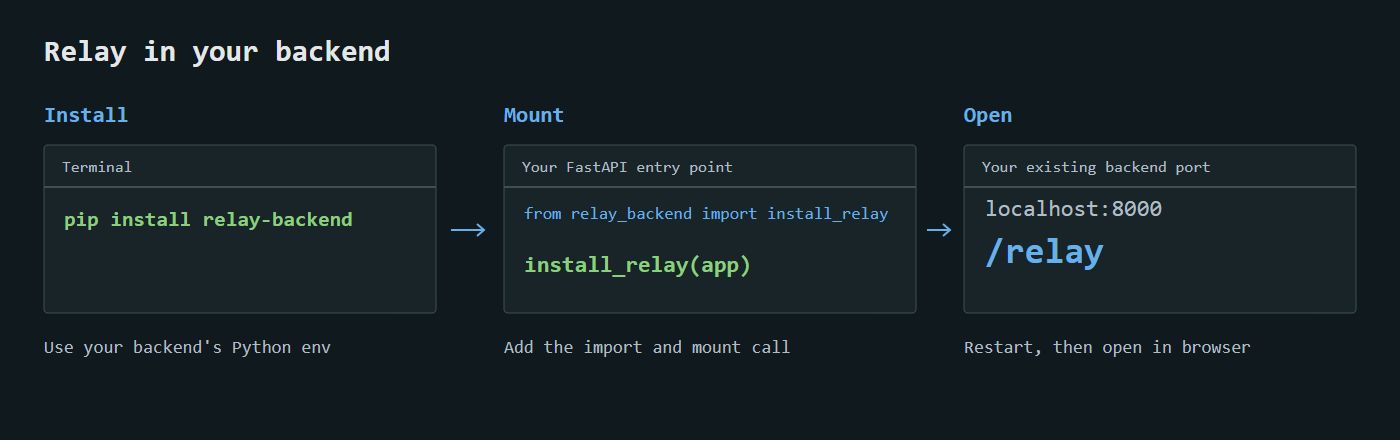
Quick start
Install in your backend's Python environment:
python -m pip install relay-backend
In the file where app = FastAPI() is created:
from relay_backend import install_relay
install_relay(app)
Restart your backend normally. Open /relay on its existing port. That is all the required configuration.
Node backends
The relay-backend npm package is published for Express, Fastify and Node HTTP. The UI is bundled; Python is not needed. See Node integration for JavaScript and TypeScript setup.
Next release
0.0.6 roadmap: session request history, lightweight response checks, reviewed exports and realtime diagnostics. Implementation is in progress; realtime diagnostics, session request history and response checks are complete in source; reviewed exports and release gates remain pending.
Guides
New in 0.0.5: realtime team setup, reviewed Git migration and upgrades. Existing setup tools include guided setup and diagnostics, local endpoint notes/activity and persistent contract-change explanations.
- FastAPI integration: installation, existing apps, factories, development flags, Socket.IO and optional settings.
- Testing APIs: inputs, shared and endpoint auth, responses, limits and shortcuts.
- Git workflow: statuses, source authors, commit/pull sharing and conflicts.
- Exports: Relay reports, JSON, saved responses and file associations.
- Troubleshooting: missing
/relay, installation, auth, schemas and reports.
For maintainers: v0.0.4 plan, contributor setup, release process, architecture, distribution and changelog.
Python 3.11+ is required. This is a local development tool: loopback clients/hosts only. Native execution runs real backend handlers and can modify development data. There is no Relay cloud or editable endpoint definition. Optional automatic team status sync exchanges status metadata on a separate Git branch. Done is a manual team status, not test/security approval.