
Search guides and reference sections.
Relay / Developer documentation
Node integration
The published npm distribution is relay-backend, version 0.0.3. It contains the compiled Relay UI and native Node implementation. Python is not needed. Node 22.13+ is required.
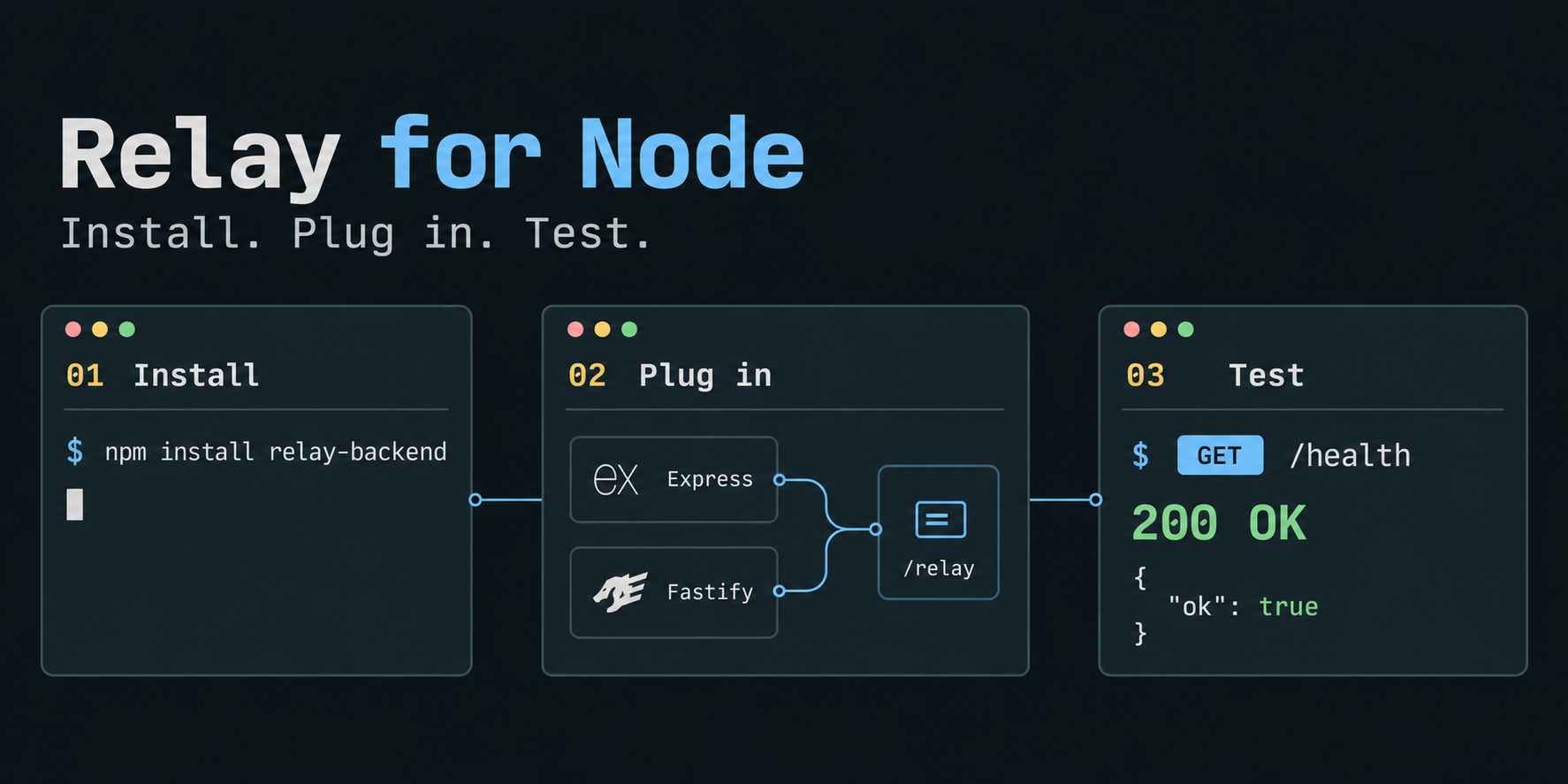
npm install relay-backend
For an existing installation, npm install relay-backend@latest upgrades the package. npm resolves the latest release when installing a new dependency; an existing lockfile preserves the version it records.
See the package quick start for Express and Fastify. Both CommonJS require('relay-backend') and ESM import work, including TypeScript declarations.
Where the schema comes from
Relay uses your generated OpenAPI 3.0/3.1 JSON. It never edits endpoint definitions. Express integration takes openapi: document, a synchronous/asynchronous provider, or fetches /openapi.json from the same backend by default. Fastify integration uses app.swagger() when available. Register the Swagger generator before your API routes and Relay.
For a custom JSON route, use specPath: '/api/openapi.json'. The title comes from info.title: My Portal becomes Relay - My Portal.
Express does not include a schema generator. Keep using your current generator; undocumented routes and TypeScript interfaces cannot be discovered as complete request contracts. NestJS can produce a document using its Swagger integration, but it has no dedicated tested Relay adapter in this release. Deno, Bun, serverless environments and other frameworks are not part of the verified Node support.
Options
| Option | Default | Meaning |
|---|---|---|
openapi |
Same-app /openapi.json |
JSON document or provider returning one |
enabled |
true |
false registers no tester routes |
specPath |
/openapi.json |
Same-app generated JSON schema route |
project |
Git repository above the working directory | Explicit repository path; false disables Git |
syncStatus |
false |
Automatically exchange statuses with Git origin |
dataDir |
~/.relay |
Local metadata folder; false keeps workspace metadata in memory |
target |
Current backend origin | Loopback HTTP(S) origin for standalone use |
dataDir: false does not disable Git persistence; set project: false as well for entirely temporary statuses. syncStatus needs Git identity and remote access. Each process owns its local workspace; share statuses through Git rather than pointing multiple workers at the same metadata file.
Mount at the application root. This version serves /relay and /relay/; mounting below another path prefix is not supported. Install Express middleware before body parsers and catch-all routes. Keep Relay disabled in production. Existing backend authentication hooks remain active: allow local Relay routes through broad hooks and authenticate individual test requests using Relay's Auth controls.
Node HTTP
import http from 'node:http';
import { relay } from 'relay-backend';
import { openapi } from './generated-openapi.js';

const tester = relay({ openapi });
const server = http.createServer((req, res) => {
  void tester(req, res, () => {
    // Your existing request handler.
    res.writeHead(404).end();
  });
});
server.on('close', () => void tester.close());
server.listen(3000, '127.0.0.1');
Express/Node integrations should call tester.close() at shutdown, especially with team sync enabled. The Fastify adapter registers its own onClose hook.
Limits and privacy
Relay accepts only loopback client addresses and hosts. Unsafe tester requests require its local CSRF token and matching Origin. The request runner rejects arbitrary external destinations, recursive Relay requests and unsafe forwarded headers. It does not follow redirects or retain a cookie jar. Responses are capped at 2 MiB and request JSON at 1 MiB, with truncation/limit feedback.
Authentication tokens and request drafts remain in browser session memory. Exports deliberately include captured data; review them before sharing. Local workspace metadata stores statuses, contract fingerprints and activity, not API traffic. Git sync stores endpoint status and the updater's configured Git identity. It does not currently attribute Node handler authors.
Missing dependency
If Node says it cannot find relay-backend, run npm install relay-backend in the backend directory and restart. Python backends use pip install relay-backend instead. Installing one distribution does not install the other.
Verification
The test suite exercises actual Express and Fastify servers, schema discovery, existing authentication hooks, request body/query handling, response limits, redirects, CSRF, persistent statuses and independent Git peers. Release checks also install the packed tarball outside the repository and test both JavaScript module formats and TypeScript consumers.
Optional realtime statuses (0.0.5)
Existing native integrations remain valid after upgrading. Configure RELAY_TEAM_URL, RELAY_TEAM_PROJECT and your private RELAY_TEAM_TOKEN to use the optional shared service; Python installs relay-backend[realtime]. Disable the old Git sync option before selecting realtime. The /relay/ import preview can move matching Git statuses without overwriting existing team records or changing Git files. API testing remains local and works during collaboration outages.