
Search guides and reference sections.
Relay / Developer documentation
Relay architecture
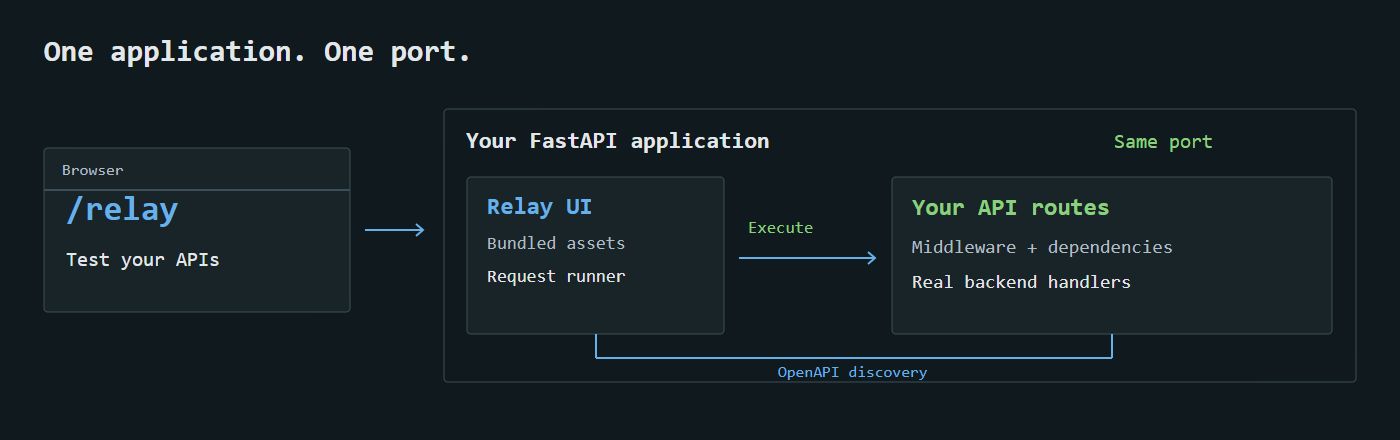
Native FastAPI mounts the compiled React UI, assets, and internal /__relay API under /relay. The standalone CLI serves the same namespaced UI and retains its legacy root /__relay API. security.py checks origins, paths, and headers; openapi.py normalizes code-generated contracts; executor.py runs bounded HTTPX requests without redirects or ambient proxies.
Operations.tsx categorizes endpoints by OpenAPI tags. Playground.tsx builds editable request inputs and displays real response text. Imported methods, paths, schemas, and categories are never edited in Relay. Changed fingerprints reset obsolete drafts; unchanged syncs preserve session inputs/results. Failed imports preserve the previous in-memory snapshot.
App.tsx opens shared and endpoint authorization in a compact dialog, applies tokens only on submission, and keeps credentials in React memory. Playground.tsx exposes advanced auth overrides inline; its execution action sits above the request. Headers and code snippets use labeled disclosures. Request drafts and live results also stay in session memory, capped at twenty endpoints. Reload clears them. Copy actions support resolved URLs, headers, and the selected response representation. Code snippets redact common credential fields.
workspace.py persists local status in SQLite. git_status.py optionally overlays shared .relay/status.json, using atomic writes and a lock. It records Git-configured identity, not authenticated users. Without automatic sync, Git sharing uses normal commits and pulls. With sync_status=True, status_sync.py exchanges status metadata on a separate relay-status branch. Changed contracts invalidate Done without fabricating a new teammate action. Neither HTTP success nor status grants an approval.
integration.py mounts a development subapplication excluded from OpenAPI and composes its resource lifespan with the host lifespan. It reads the host OpenAPI function and executes through the host ASGI middleware/dependency stack without subprocesses or extra ports. Response retention is capped before HTTPX buffers the ASGI body; each execution gets a fresh cookie jar. Remote clients cannot access Relay. The CLI remains available independently. scripts/package.py bundles assets into a Python wheel, and scripts/verify_package.py verifies an isolated installation.
Browser execution payloads supply relative paths only. Exact Host/Origin/Fetch Metadata/CSRF checks protect the runner; limits bound requests, responses, and execution time. This boundary blocks unrelated browser origins, not malicious local processes. Responses render as text. There is no cloud executor or public production integration.
Contract snapshots are ephemeral. Automatic status synchronization polls the Git remote every ten seconds; visible browser tabs refresh workspace metadata every five seconds. It commits a status-only tree and never checks out a branch, stages files, merges code or forces a push. Concurrent pushes retry after merging the latest endpoint edits. No hosted collaboration service is required. The UI stays focused on testing plus an endpoint status selector.
Native Node adapters
packages/node/lib/index.cjs provides Express/Node HTTP middleware and a Fastify plugin; index.mjs exposes the same implementation to ESM. The package includes TypeScript declarations without a required Fastify dependency. Native HTTP requests loop back through the real backend handlers and middleware on its existing port. openapi.cjs normalizes generated schemas; runner.cjs enforces bounded requests and responses. No Python subprocess is involved.
workspace.cjs stores local status metadata in JSON. git.cjs handles optional status-file persistence and automatic Git exchange. The frontend, exports and themes are shared with Python. scripts/package_node.cjs bundles assets into the npm tarball; scripts/verify_node_package.cjs tests a clean packed or registry installation.
Setup and handoff in 0.0.4
Both CLIs inspect bounded source trees without executing application code. init previews conservative integration edits; applying a supported edit uses atomic replacement. doctor checks only supplied local schema/health routes and local Git configuration, with sanitized output.
Workspace metadata stores local notes, at most 100 recent events, a persistent contract-review flag and small per-section digests. Digests identify changed contract sections without storing full historical schemas or captured request traffic. Python uses additive SQLite columns; Node extends its existing version-1 JSON rows with optional fields and a separate 16 MiB metadata cap. Failed Node writes roll back in-memory edits, and stale status updates are rejected even when schema inspection runs during an awaited Git write.
The UI keeps unsaved notes in session memory, distinguishes schema refresh from Git team sync and permits explicit worker retries through the existing same-origin/CSRF boundary. Shared Git metadata remains status-only. Full schemas remain ephemeral; request traffic and credentials are not written by these features.
A shared Socket.IO status service is proposed for v0.0.5 in November 2026. It does not replace current local/Git workflows.