
Search guides and reference sections.
Relay / Developer documentation
FastAPI integration
Install and mount
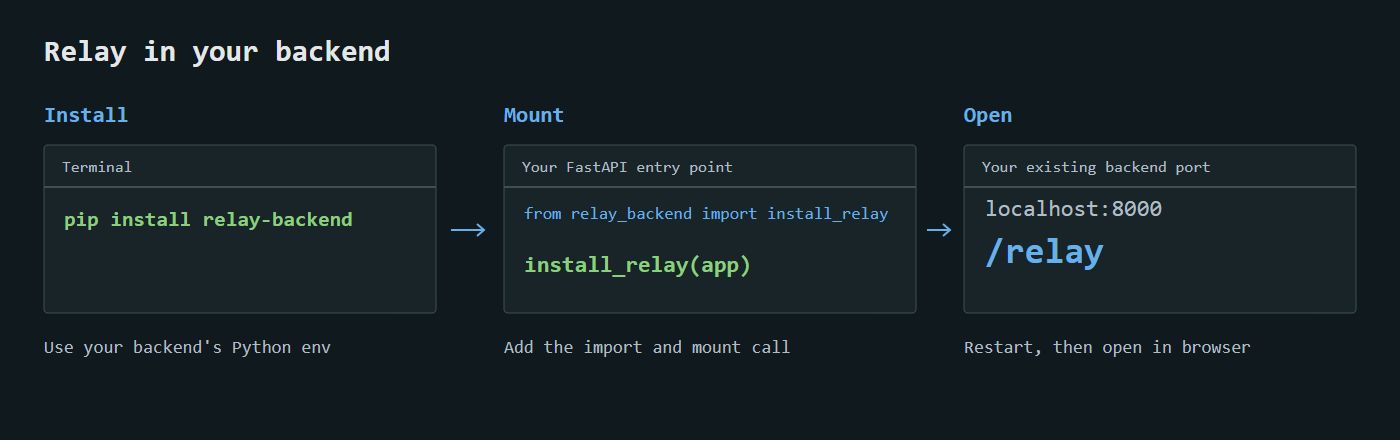
Install in your backend's Python environment:
python -m pip install relay-backend
A fresh installation gets the latest stable release. To update an existing installation:
python -m pip install --upgrade relay-backend
Restart the backend after upgrading. The browser title uses your application's name: FastAPI(title="Ludo Portal") becomes Relay - Ludo Portal. Any application's title works.
In the file where your existing FastAPI instance is created:
from relay_backend import install_relay
install_relay(app)
Start your backend normally. If its port is 8081, open http://localhost:8081/relay/. /relay redirects to the trailing-slash URL. Swagger /docs remains available.
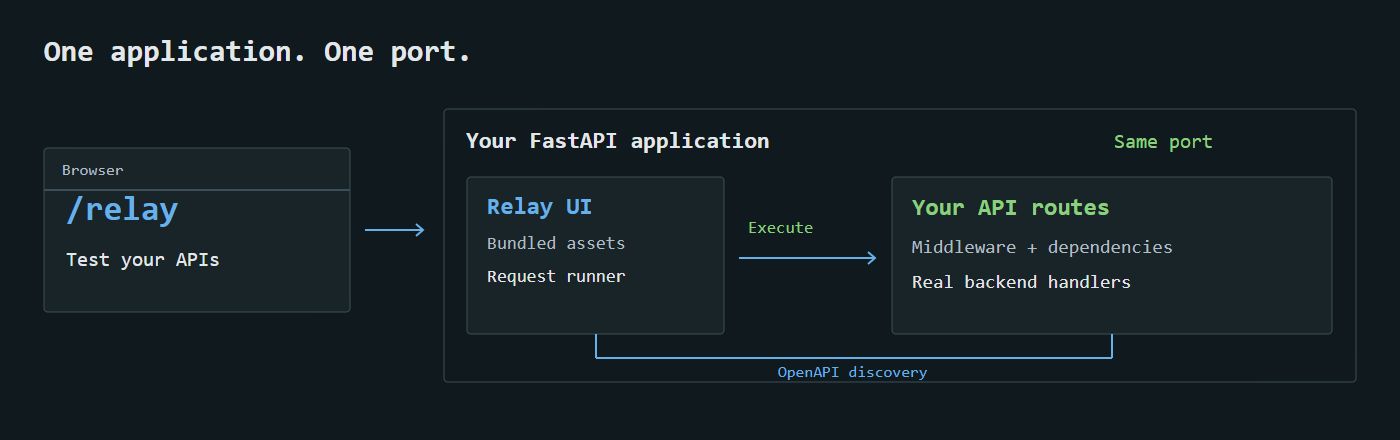
The wheel includes UI, fonts and branding. No Node, source clone, CDN, frontend build, target URL or separate Relay process is required. Native integration reads app.openapi() directly and runs tests inside your host application.
Complete example
# main.py
from fastapi import FastAPI
from relay_backend import install_relay

app = FastAPI(title="Example")

@app.get("/health", tags=["System"])
def health():
    return {"status": "ok"}

install_relay(app)
python -m uvicorn main:app --reload
Open http://localhost:8000/relay/, expand System → GET /health, then Execute request. Expect HTTP 200 and {"status":"ok"}.
A larger runnable example covers routers, an application factory, nested/optional bodies, query arrays, empty responses and separate user-token / admin-token demo credentials. Save that single file as main.py beside your installed package and run the same Uvicorn command. It does not require cloning Relay or building the UI. Its routes only echo example data; the tokens illustrate authentication and are not a production security implementation.
Development flag
install_relay(app, enabled=settings.DEBUG)
Use your application's actual settings object. Relay does not infer production from arbitrary environment names. enabled=False returns None without mounting, modifying lifespan or creating Relay storage/resources. Otherwise the return value is the mounted sub-application, also available as app.state.relay.
Factories and routers
def create_app():
    app = FastAPI(lifespan=lifespan)
    app.include_router(api_router)
    install_relay(app, enabled=settings.DEBUG)
    return app
Mount once per app instance. Duplicate mounting and an existing /relay namespace produce explicit errors. /relay is fixed in v0.0.3. Routes can be included before or after mounting, before startup.
Socket.IO and wrappers
fastapi_app = FastAPI()
fastapi_app.include_router(api_router)
install_relay(fastapi_app, enabled=settings.DEBUG)
app = socketio.ASGIApp(sio, other_asgi_app=fastapi_app)
Install on FastAPI before wrapping it; the outer ASGI wrapper is not a FastAPI instance. Native tests invoke the FastAPI host, including its middleware, dependencies and handlers. Middleware exclusively outside that host is not tested by this internal execution path.
Configuration reference
| Option | Default | Purpose |
|---|---|---|
enabled |
True |
Your development flag. |
sync_status |
False |
Automatically exchange statuses through the existing Git remote; see team setup. |
project |
Git repository detected upward from process cwd | Shared statuses and source attribution; pass pathlib.Path. |
data_dir |
~/.relay |
Per-project/app local workspace storage. |
db_path |
Derived workspace SQLite path | Explicit path or ":memory:" for tests. |
static_dir |
Bundled UI | Contributor override; unnecessary for consumers. |
from pathlib import Path
install_relay(app, project=Path(__file__).resolve().parent)
Workspace identity uses resolved project/working directory and app title. Changing those can select a new workspace. Start from your project directory for consistent Git detection.
Schema and lifespan
Custom/disabled public OpenAPI URLs and custom app.openapi() generators work. FastAPI caches OpenAPI; restart after route edits or clear app.openapi_schema for dynamic route updates. Sync re-reads your schema but cannot bypass the host's own cache.
The parent lifespan starts first and stops last. Relay's resources run inside it and preserve yielded host state. Keep existing startup/shutdown logic. Local mounted root_path prefixes are supported; loopback checks still apply.
Install from a release file
Download the wheel from the v0.0.3 release, then install it with the same consumer integration:
python -m pip install /path/to/relay_backend-0.0.3-py3-none-any.whl
relay-agent on PyPI is an unrelated project; the distribution to use is relay-backend.
Optional realtime statuses (0.0.5)
Existing native integrations remain valid after upgrading. Configure RELAY_TEAM_URL, RELAY_TEAM_PROJECT and your private RELAY_TEAM_TOKEN to use the optional shared service; Python installs relay-backend[realtime]. Disable the old Git sync option before selecting realtime. The /relay/ import preview can move matching Git statuses without overwriting existing team records or changing Git files. API testing remains local and works during collaboration outages.